Service Area · SL9Gerrards Cross
Gerrards Cross
Flooring Fitters.
Bucks commuter village · Fixed price · SL9 including Chalfont St Peter & Chalfont St Giles
Bucks commuter village · Fixed price · SL9 including Chalfont St Peter & Chalfont St Giles
"Chalfont St Giles and Jordans are among the oldest continuously inhabited settlements in Buckinghamshire. The floors beneath their historic cottages have centuries of movement, settlement and patch repairs behind them — getting a new floor to sit flat and stay flat demands a completely different approach to a modern build."Chalfont St Giles & Jordans historic cottages
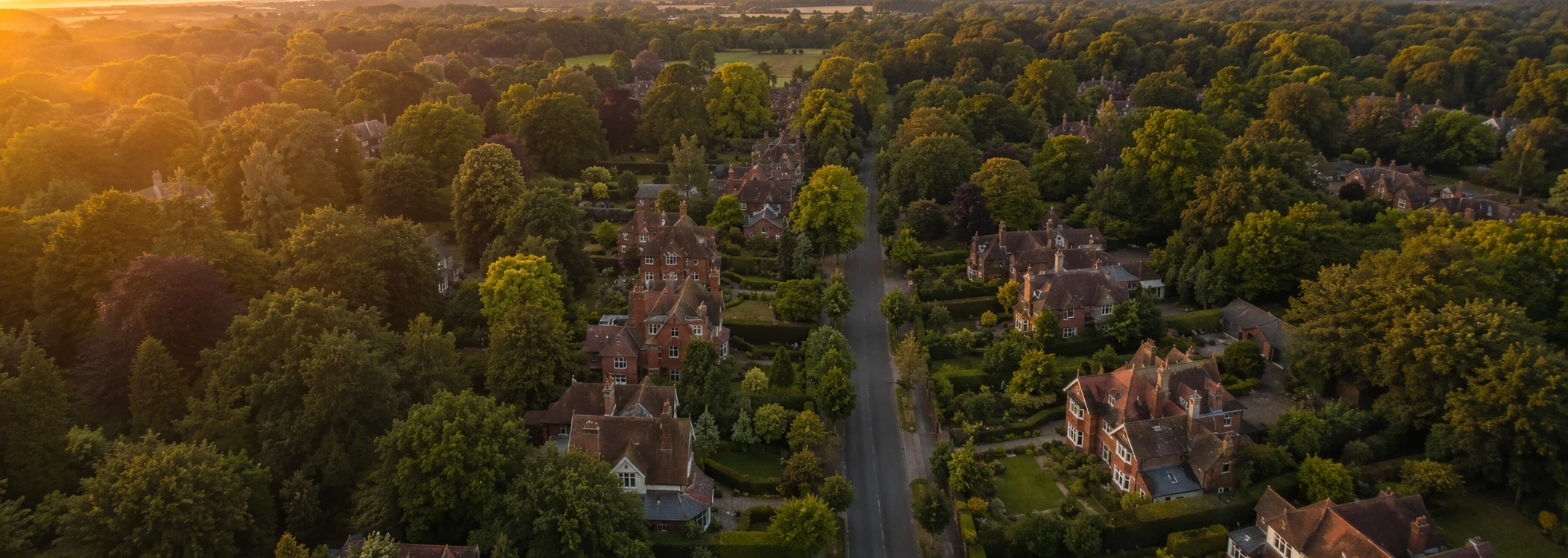
The large Edwardian and inter-war detached houses that line Gerrards Cross's wooded roads and private lanes are built on suspended timber throughout — joists spanning generous room widths over an underfloor void. These properties often have distinct level changes where a servants' wing or rear extension was built to a different datum than the main house, creating a 15–25mm step between rooms that must be resolved before any continuous floor can be laid. We re-fix loose boards, install 18mm structural ply across the full floor to eliminate spring and create a consistent datum, and use self-levelling compound at thresholds to marry the levels cleanly. For the wide reception rooms and hallways of these houses, wide-board engineered oak in a 190–220mm format — brushed, oiled or lye-treated — is the product that reads in proportion with the room scale and tall original skirtings.
Chalfont St Giles is one of Buckinghamshire's best-preserved medieval villages, and many of its listed and unlisted cottages retain original stone-flag ground floors or early limecrete bases laid directly on compacted earth — with no damp-proof membrane whatsoever. Moisture readings in these properties are frequently high; even where the stone feels dry, vapour transmission can be significant depending on season and weather. We assess residual moisture carefully using a calibrated hygrometer before specifying any product. Where levels permit, glue-down LVT on top of a brush-applied epoxy surface DPM is often the right answer — it tolerates minor ongoing moisture transmission, requires no expansion gap at the irregular stone walls, and lies flat over the undulations that centuries of settlement produce. In properties where the character of the original floor must be preserved under conservation conditions, we advise on approach at the home visit before recommending any product.
The executive new builds that have appeared across SL9 over the past two decades — particularly on former garden plots and small private road developments — are universally specified with concrete ground floors and wet underfloor heating embedded in the screed. This is technically the most demanding subfloor for product selection: solid wood is ruled out entirely, click-fit floating floors are unreliable above UFH (they bridge and creak as the screed cycles through heat), and the screed itself must be fully cured and below 75% relative humidity before any floor is installed. We confirm the system's maximum flow temperature in writing, carry out a moisture test on the day of the home visit, and specify either glue-down LVT or engineered boards with a declared total thermal resistance below 0.15 m²K/W. The large open-plan kitchen-dining-living areas in these homes often exceed 60m²; we plan the board layout at the visit to eliminate any visible centre join and keep cuts in the least visible positions.
Chalfont St Peter's substantial 1950s–70s semi-detached stock sits on solid concrete ground floors poured in an era when building practice was inconsistent on damp-proofing. Some properties from this period have an effective DPM; many do not, or have a membrane that has degraded over time. The upper floors retain original suspended timber throughout, which requires separate treatment. On the ground floor, we always carry out a moisture test before recommending a product — glue-down LVT is the most tolerant of residual dampness, and on a clean, flat concrete surface it delivers a crisp contemporary result in kitchens, hallways and living rooms. Where the reading is borderline, a brush-applied surface DPM brings moisture levels into the safe range before the floor goes down. Upstairs, 18mm ply over the original boards provides a stable base for carpet or a floating engineered floor, and we quote both floors together on a single fixed price.
We're based in Slough — SL9 is on our doorstep. There is no call-out charge and the home visit is completely free. We cover Gerrards Cross town, Chalfont St Peter, Chalfont St Giles, Jordans and Seer Green without any surcharge or minimum order.
Yes, and we do this regularly in the SL9 villages. Original stone flags present two main challenges: they're rarely level, and they frequently transmit moisture from the ground below. At the home visit we assess both — measuring floor heights across the room and testing moisture levels — before recommending a product. In most cases glue-down LVT over a surface DPM is the right answer; it tolerates minor residual damp, lies flat over stone undulations, and doesn't require the stone to be lifted or replaced.
LVT glued direct to the screed is the most reliable choice above wet UFH — it has virtually no thermal resistance, meaning the heating system works at full efficiency. Certain engineered wood products are also compatible, provided the total thermal resistance of board plus adhesive stays below 0.15 m²K/W. We confirm compatibility at the visit and provide the specification in writing. We do not fit click-lock floating floors above wet UFH systems.
We bring a premium sample range to your door, measure up and price the full project — including subfloor assessment at no extra charge. No obligation, no deposit.
Last updated: May 2026