Service Area · SM1–SM3Sutton
Sutton
Flooring Fitters.
South London / Surrey · Fixed price · Free home visit · SM1–SM3
South London / Surrey · Fixed price · Free home visit · SM1–SM3
"Cheam's 1920s–30s Conservation Area properties were built for respectable suburban families on the North Downs fringe — chalk subsoil provides exceptional drainage, which means subfloor moisture is rarely the complication here that it is in clay-belt London properties."SM1–SM3 housing character
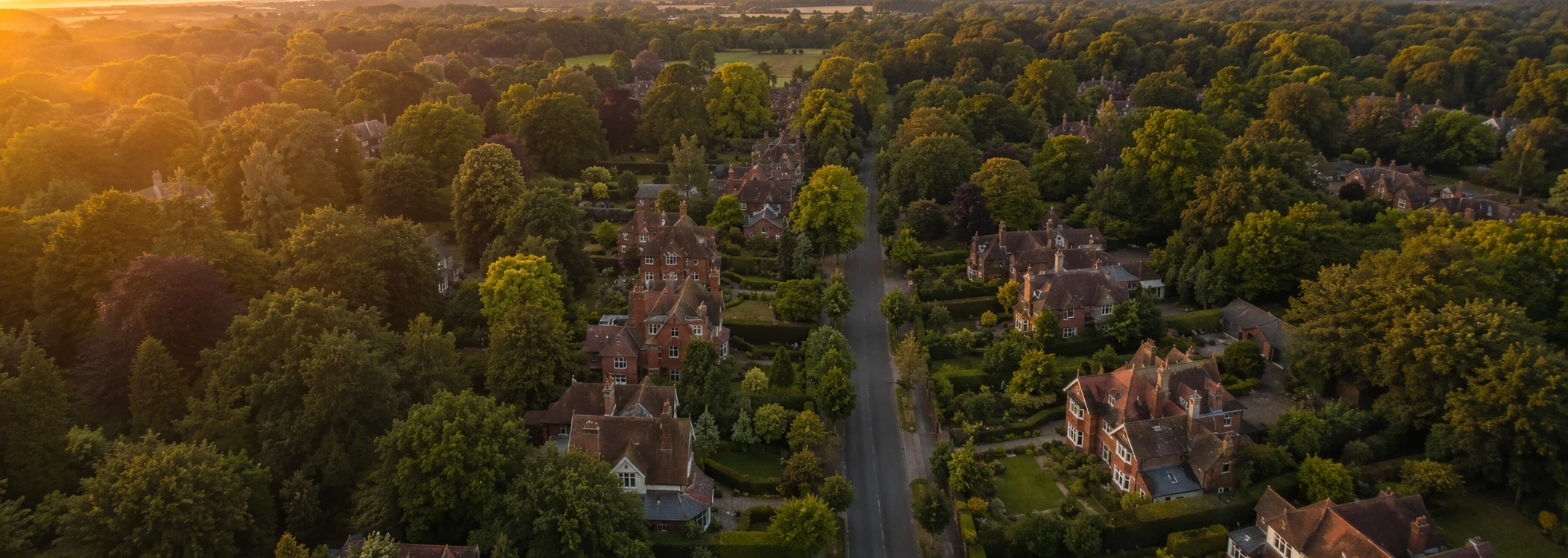
Sutton's SM1–SM3 postcodes span 1920s–30s semis and detached homes in Cheam Conservation Area, Victorian and Edwardian properties in Belmont, 1930s semis in North Cheam and the Nonsuch estate, and Victorian terraces in Sutton town centre. The chalk geology of the area means subfloor moisture is generally lower than equivalent London clay-belt properties. We survey every property at the free home visit and price the full job on the day.
Cheam — Church Road, Cheam Road, Worcester Park Road SM3 — contains a substantial number of 1920s and 1930s detached and semi-detached homes within the Cheam Village Conservation Area. These properties were built for professional families and the construction standard reflects that: suspended timber in deal boards of 120–140mm width, joists in good condition. The chalk and greensand geology beneath Cheam provides exceptional subsoil drainage, which means moisture readings in ground-floor voids are consistently low. This is a significant advantage: the chalk subsoil means we rarely need to specify DPM treatments or moisture-resistant products on a precautionary basis, as we would in comparable properties on London clay. Original boards in Cheam properties are frequently in very good condition. Wide-plank engineered oak or premium carpet suit the well-proportioned rooms of these inter-war homes.
Belmont — Stanley Road, Brighton Road, Belmont Rise SM2 — sits on the elevated chalk escarpment of the North Downs, with some of the best natural subfloor drainage of any area we serve. Victorian and Edwardian properties (1875–1912) here have suspended timber with deal boards in good original condition, and the elevated chalk position means ground moisture is consistently the lowest we measure in the SM postcode area. The Victorian terraces on Stanley Road and Belmont Rise were built for railway workers and lower-middle-class families — standard construction quality, deal boards 100–125mm wide. Edwardian properties are slightly better built and have boards of 125–150mm in good original condition. We still survey and ply as standard, but preparation in Belmont is more straightforward than in the clay-belt areas of north Surrey.
North Cheam — Stonecot Hill, Ewell Road, Northey Avenue SM3 — and the Nonsuch estate were developed in the 1930s as part of the suburban expansion along the route of the London to Epsom road. Semi-detached houses built to a consistent standard: deal boards 100–125mm wide, joists at 400mm centres, ground floor 300mm above ground level. The Nonsuch estate in particular was built in a planned campaign to a uniform design brief, which means subfloor quality across the estate is unusually consistent — similar to the Southfields Edwardian estate in its predictability. Board condition is generally above average for 1930s stock. Kitchen extensions create the standard concrete zone; we survey, price and manage both zones as standard.
Sutton town centre — High Street, Lind Road, Throwley Way SM1 — has a mix of Victorian terraces (1875–1895) and post-war rebuilding. Victorian stock has standard suspended timber. Properties closest to the High Street and the commercial core have in many cases had ground-floor rooms used as shops, offices or consulting rooms at various points — concrete may have been introduced in ground floors during commercial occupation. Post-war rebuilds in the town centre after WWII bombing are on solid concrete. We survey every property at the home visit; the wide range of subfloor conditions in the town centre means we cannot price without a site visit. Properties on purely residential streets away from the commercial centre have more predictable Victorian suspended timber.
We come to you with a full sample range, measure every room and price the job on the spot. No deposit, no obligation.
Every quote includes materials, fitting, underlay, door bars and uplift of the old floor. The number we give you is the number you pay.
If anything lifts, gaps or comes loose within 12 months, we return and fix it free of charge — no quibble, no call-out fee.
Yes — we cover the full SM1, SM2 and SM3 postcode area including Cheam, Belmont, North Cheam, Nonsuch and all surrounding areas. No call-out charge and free home visits including evenings and weekends.
Yes, in most cases. Cheam's 1930s semis are well-built and the deal boards are typically in good condition under carpet. We assess, re-nail any movement, add ply and fit over the top. More cost-effective than concrete and preserves the original floor structure.
Belmont sits on chalk, which means excellent drainage and consistently low subfloor moisture. This makes Belmont properties among the more straightforward for flooring specification — moisture is rarely a complication here.
We can usually arrange a visit within 2–5 working days across SM1–SM3. Evening and weekend appointments available at no extra charge. No call-out charge anywhere in Sutton.
Yes. Uplift and disposal is included as standard on all fitting jobs. All part of the fixed price. Call 07836 446951 to book your free visit.
We bring a full sample range to your door, measure up and price the full project in a single visit. No obligation, no deposit.
Last updated: June 2026